
Gas Monitors

Portable Gas Monitors & Multi-Gas Detectors
Portable gas detection is required wherever workers may be exposed to oxygen deficiency, flammable gases, or toxic atmospheric contaminants. OSHA 29 CFR 1910.146 mandates atmospheric testing before and continuously during any permit-required confined space entry. OSHA 29 CFR 1910.1000 governs permissible exposure limits (PELs) for toxic substances in general industry. Gas monitors are also required under OSHA's hot work, welding, and process safety management standards wherever hazardous gases may accumulate.
Safe-Fast stocks 13 portable gas detection products from BW Technologies (Honeywell), Dräger, and RKI Instruments:
- Single-Gas Monitors — for known, targeted atmospheric hazards:
- BW Clip Real-Time — up to 3 years of continuous maintenance-free operation. Available for CO, H₂S, O₂, and SO₂. Always on; no battery or sensor changes required.
- BW Solo (Honeywell) — serviceable single-gas detector with Bluetooth Low Energy (BLE) for real-time cloud connectivity to the Honeywell Safety Suite fleet management platform.
- RKI 04 Series Single Gas Monitors — field-replaceable sensors and filters for long service life. Available in CO ($205) and NO₂ ($520) configurations.
- 4-Gas Monitors — simultaneous O₂, LEL, CO, and H₂S detection for complete confined space atmospheric assessment:
- BW Clip4 — 2-year continuous runtime; always-on, single-button operation. Clip it on and get the job done — no daily charging.
- BW Flex4 — 2-month battery runtime on a 4.5-hour charge using a low-power IR LEL sensor. Compatible with Honeywell BW™ fleet management.
- GasAlert Max XT II — one-button operation; designed for simplicity and worker compliance. LCD display with audio/visual/vibrating alarms.
- Honeywell BW MicroClip X3 — world's most popular multi-gas detector; long runtime, small form factor, and easy user experience.
- Dräger X-am® 2800 — up to 4-gas detection with shock-resistant CatEx SR sensor. Connects to Dräger Gas Detection Connect software for live fleet monitoring.
- RKI GX-3R — world's smallest 4-gas monitor at 3.52 oz; clips within the breathing zone.
- Sample Draw Monitors — for remote or pre-entry atmospheric testing from outside the space:
- RKI GX-Force — internal pump capable of 100' sampling range; 4-gas simultaneous detection.
- RKI GX-3R + RP-3R Bundle — GX-3R paired with a sample draw pump and 10' hose for confined space pre-entry testing.
Gas monitors must be bump-tested before each use and fully calibrated at manufacturer-specified intervals — typically every 6 months. Safe-Fast provides gas monitor service, calibration, and repair. Equipment rental is available for project-based confined space entries. Call 1-800-723-3620.
- Product
- Qty in Cart
- Quantity
- Price
- Subtotal
-
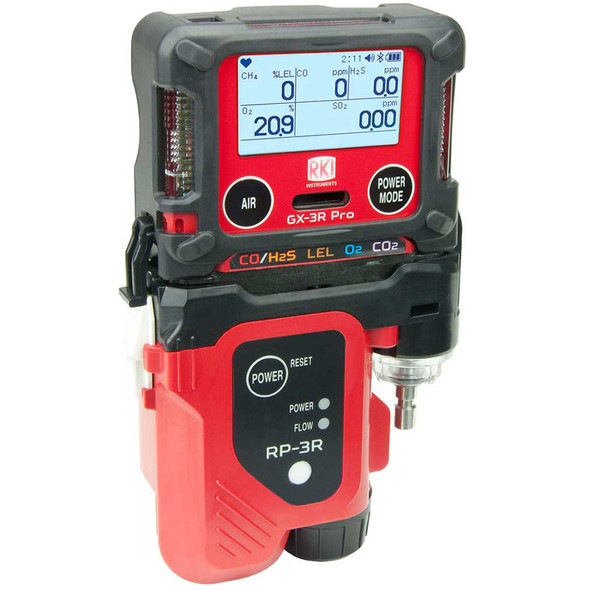

RP-3R Sample Draw Pump 81-1198
RKI Instruments
$450.00Clip-on Motorized Sample Drawing Pump for GX-3R (Pro) The RP-3R are compact, battery operated, motorized sample drawing pumps which attach to either the GX-3R or the GX-3R Pro to change them from...$450.00
Gas Monitors — Frequently Asked Questions
A bump test (also called a functional test) is a brief exposure of the gas monitor's sensors to a known concentration of test gas to verify that the sensors respond and alarms activate. It confirms the instrument is operational but does not adjust the instrument's calibration curve. OSHA and instrument manufacturers require bump testing before each day's use.
A full calibration exposes sensors to known reference gas concentrations and adjusts the instrument's readings to match those reference values. It corrects for sensor drift over time. Most manufacturers specify full calibration every 6 months at minimum — more frequently if the instrument is used in harsh conditions, after any sensor alarm event, or if the bump test indicates a failing response. Safe-Fast provides certified calibration services.
All 4-gas monitors in this category simultaneously detect the four primary atmospheric hazards in confined spaces and industrial environments:
- O₂ (Oxygen): monitors for deficiency (<19.5%) and enrichment (>23.5%)
- LEL (Lower Explosive Limit): flammable gas/vapor concentration as a percentage of the lower explosive limit — typically methane (CH₄) or pentane-equivalent
- CO (Carbon Monoxide): common in combustion environments, confined spaces near vehicle exhaust, and industrial processes
- H₂S (Hydrogen Sulfide): found in sewers, petrochemical facilities, wastewater treatment, and agricultural environments
This 4-gas combination satisfies the OSHA 1910.146 requirement to test for all atmospheric hazards before and during confined space entry.
The BW Clip Real-Time and BW Clip4 are designed to run continuously for their rated service life (3 years for the Clip, 2 years for the Clip4) without worker interaction. The advantages:
- Eliminates start-up failures: a monitor that must be switched on each day can be forgotten or skipped. An always-on device eliminates this compliance gap.
- Eliminates maintenance burden: no battery charging, no sensor replacement, no daily activation — workers clip it on and work.
- Continuous exposure record: the device monitors atmospheric conditions from the moment it's worn, not just when a worker remembers to turn it on.
At end of service life, the device is replaced rather than repaired, ensuring consistent sensor performance across its rated life.
A personal wearable monitor (clip-on style) is worn in the worker's breathing zone to provide continuous personal exposure monitoring during occupancy. It detects hazards as they develop in real time around the worker.
A sample draw monitor uses an internal pump to pull air from a remote location through a hose, allowing atmospheric testing before the worker enters the space. This is critical for:
- Pre-entry testing of confined spaces where inserting a person to test would expose them to the hazard being measured
- Testing at depth (bottom of a tank or vault) from a safe outside position — the RKI GX-Force draws samples from up to 100 feet
- Testing multiple zones within a large space without walking to each location
For most confined space programs, both are needed: a sample draw monitor for pre-entry testing and personal wearable monitors for each entrant during occupancy.